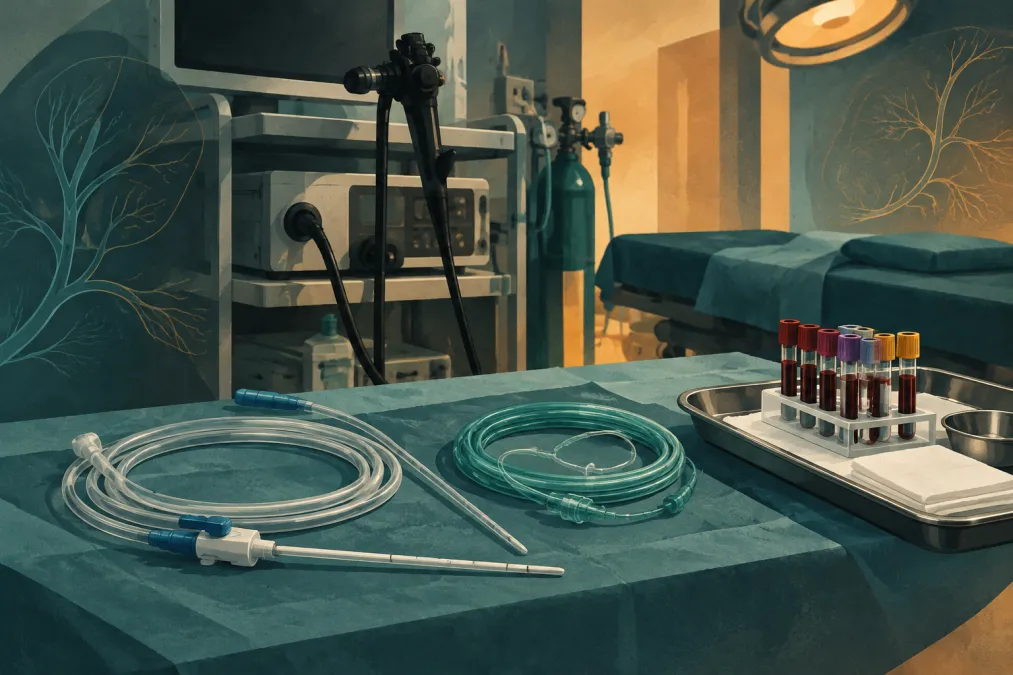
A patient with cirrhosis arrives after a large haematemesis and needs urgent endoscopy. The examiner’s first question is not whether you can list the complications of portal hypertension. It is whether you will intubate—and why.
The decision is not automatic. Active haematemesis and altered consciousness make airway protection a priority, but an intubation can also precipitate cardiovascular collapse in a shocked patient. Your answer should connect the airway decision to the patient’s current physiology and the procedure planned, while resuscitation and haemostasis proceed in parallel.
Make the first minutes count
Call for senior anaesthetic help and bring the endoscopist, intensive-care team and blood bank into the discussion early. Assess airway, breathing and circulation; apply monitoring and give oxygen as clinically indicated. Establish large-bore intravenous access, send blood for urgent testing and crossmatch, and activate the local major-haemorrhage pathway if bleeding is immediately life-threatening. Do not wait for a haemoglobin result to treat a visibly shocked patient who is continuing to bleed.
A crisis leader should coordinate the work so that resuscitation, airway preparation and planning for endoscopy happen together. Alert interventional radiology early if bleeding is severe or first-line haemostasis may fail. Request a full blood count, blood gas with lactate, electrolytes, renal and liver function, coagulation tests and fibrinogen. Check glucose, temperature and ECG. Review anticoagulant or antiplatelet drugs, previous variceal treatment, renal function and the patient’s usual mental state. Investigate infection when suspected, without delaying initial treatment.
Read the whole patient, not just the INR
Look for ascites, jaundice, muscle wasting and encephalopathy. Repeated fresh haematemesis, melaena, perfusion, mental state, lactate and response to initial resuscitation help show how severe the bleed is. A normal early haemoglobin does not exclude major acute blood loss. Renal dysfunction, infection, electrolyte disturbance and hypoglycaemia can worsen both encephalopathy and haemodynamic instability. Consider aspiration and alternative sources of upper gastrointestinal bleeding; endoscopy establishes the source.
Child–Pugh and Model for End-Stage Liver Disease (MELD) scores help describe disease severity and inform prognosis and risk assessment. They do not replace bedside assessment or determine whether immediate resuscitation is needed. Score the patient for risk, but treat the physiology in front of you.
An abnormal international normalised ratio (INR) is a classic viva trap. Cirrhosis alters both procoagulant and anticoagulant factors, so INR alone does not describe the overall haemostatic balance or reliably predict bleeding. Do not give fresh frozen plasma simply to normalise an INR: it does not reliably correct the coagulopathy and may cause volume overload and worsen portal hypertension. Platelet count and fibrinogen level do not, by themselves, justify routine transfusion in acute variceal bleeding. If haemostasis fails, consider platelet or fibrinogen replacement case by case, alongside the wider clinical picture and local guidance.
Make the airway decision conditional
Baveno VIII recommends intubation before endoscopy for patients with altered consciousness or active haematemesis. Respiratory compromise, cardiopulmonary status, the patient’s ability to protect the airway, the depth of sedation and the planned procedure also matter. A tracheal tube can protect an airway exposed to ongoing blood, but induction in hypovolaemia can cause profound hypotension. Intubation also carries risks, including hypoxaemia and aspiration; it is not a harmless routine step for every upper gastrointestinal bleed.
Imagine two versions of the case. In the first, the patient is drowsy with encephalopathy, repeatedly vomiting fresh blood and unable to clear secretions. Intubate before endoscopy. Prepare for a full stomach and contaminated airway: use experienced help, effective suction, a clear first-pass plan and an immediate rescue strategy. Anticipate cardiovascular collapse at induction and have blood resuscitation and vasopressor support ready.
In the second version, the patient is alert, breathing comfortably, has stopped vomiting and is protecting the airway. Cirrhosis and a previous episode of haematemesis do not, by themselves, mandate a tube. Agree the sedation and airway-rescue plan with the anaesthetic and endoscopy teams, taking account of the intended procedure and the patient’s reserve.
Shock makes induction more dangerous and may impair consciousness, but shock alone is not a rule to intubate every patient immediately. If the airway is failing, secure it. If the patient is protecting it, resuscitate and plan rather than intubating reflexively.
Resuscitate while preparing for haemostasis
The goal is to restore tissue perfusion without excessive intravascular volume expansion. Use crystalloid carefully while blood is being prepared, and give blood early when the clinical picture shows major ongoing loss. In patients stable enough for a haemoglobin-based strategy, use a restrictive red-cell target around 7–8 g/dL, individualising for cardiovascular disease, age, haemodynamic status and ongoing bleeding. This target is not a reason to withhold blood from an exsanguinating or persistently shocked patient while waiting for the haemoglobin to fall.
Keep the patient warm. During major transfusion, reassess perfusion, lactate, ionised calcium, potassium and acid–base status. Do not chase a normal INR or delay endoscopy while trying to correct it.
When variceal bleeding is suspected, start a vasoactive drug—terlipressin, octreotide or somatostatin—as soon as possible. Give antibiotic prophylaxis at presentation; choose the agent and duration according to local resistance patterns, allergies, infection risk and liver-disease severity. Arrange endoscopy within 12 hours after haemodynamic resuscitation. If the patient remains unstable, proceed as soon as the procedure can be undertaken safely.
The endoscopy setting must match the patient’s risk, with monitoring, suction, airway equipment, blood products and staff able to manage deterioration. Endoscopic variceal ligation is the usual treatment for oesophageal varices; bleeding from GOV1 may be treated with ligation or tissue adhesive. Fundal gastric varices often require a different approach, such as tissue adhesive, so confirm the plan with the endoscopist rather than assuming every varix is treated with a band.
If haemostasis fails, escalate early
Persistent bleeding despite vasoactive treatment and endoscopic therapy calls for urgent assessment for salvage transjugular intrahepatic portosystemic shunt (TIPS). A dedicated covered oesophageal self-expanding metal stent is preferred over balloon tamponade as a bridge to definitive treatment. Balloon tamponade is a temporary bridge, not an endpoint.
Do not wait for rebleeding before assessing eligibility for pre-emptive TIPS after initial haemostasis. For oesophageal or GOV1 bleeding, consider it in patients with Child–Pugh C scores of 10–13, Child–Pugh B scores above 7 with active bleeding at initial endoscopy, or a hepatic venous pressure gradient of at least 20 mmHg. Aim to place TIPS within 72 hours, preferably within 24 hours. If that window is missed, selected eligible patients may still benefit: the timing can extend to two weeks for Child–Pugh C scores of 10–13 and one week for Child–Pugh B scores above 7 with active bleeding. Involve hepatology and interventional radiology early.
Extubation is part of the airway plan
After endoscopy, reassess rather than allowing the tube to remain by default. If bleeding is controlled, the patient is awake, haemodynamically supported and able to protect the airway with adequate gas exchange, extubate as soon as clinically safe. Continue ventilation and transfer to intensive care if there is ongoing bleeding, encephalopathy, aspiration, instability or a continuing need for airway protection. Acute variceal bleeding warrants intensive-care or intermediate-care monitoring.
Once the acute episode is controlled, plan secondary prevention with the hepatology team. For oesophageal varices, this usually combines a non-selective beta-blocker with repeat endoscopic band ligation. Address infection, renal injury and encephalopathy, and assess suitability for liver transplantation when appropriate.
The distinction that earns marks is judgement under pressure: protect an airway exposed to active blood, but do not expose a stable, conscious patient to hazardous induction without a clear indication. Treat portal hypertension and the bleeding source; do not try to correct a cirrhotic INR into a number. The ANZCA Final Examination guide covers the exam itself, while the Final/Advanced Anesthesia Structured Oral Examination offers further oral-case practice.
Frequently asked questions
Should every patient with acute variceal bleeding be intubated before endoscopy?
No. Baveno VIII recommends intubation before endoscopy for altered consciousness or active haematemesis. Respiratory compromise, the ability to protect the airway, cardiopulmonary status and the planned sedation or procedure also matter. Cirrhosis alone, or a single episode of haematemesis that has stopped, is not an automatic indication.
How soon should endoscopy occur for suspected variceal bleeding?
Arrange endoscopy within 12 hours after haemodynamic resuscitation. If the patient remains unstable, proceed as soon as it is safe to do so; do not wait for the INR to normalise.
Does an elevated INR predict bleeding risk in cirrhosis?
No. INR reflects only part of the altered haemostatic balance and is not a reliable stand-alone measure of bleeding risk. Do not give fresh frozen plasma simply to normalise it.
What treatment should start before endoscopy for suspected variceal bleeding?
Start a vasoactive drug, such as terlipressin, octreotide or somatostatin, promptly. Give antibiotic prophylaxis at presentation, selecting the agent and duration according to local resistance, allergies, infection risk and liver-disease severity.
When should TIPS be considered after acute variceal bleeding?
After initial haemostasis, assess for pre-emptive TIPS in eligible patients with oesophageal or GOV1 bleeding: Child–Pugh C with 10–13 points, Child–Pugh B above 7 points with active bleeding at initial endoscopy, or hepatic venous pressure gradient at least 20 mmHg. Aim to place it within 72 hours, preferably within 24 hours. Selected eligible patients may still benefit if that window is missed; persistent bleeding despite drug and endoscopic therapy requires urgent assessment for rescue TIPS.
References
Show 4 references
- Baveno VIII – Advancing consensus in portal hypertension
- British Society of Gastroenterology guidelines on sedation in gastrointestinal endoscopy
- Endoscopic diagnosis and management of esophagogastric variceal hemorrhage: European Society of Gastrointestinal Endoscopy (ESGE) Guideline
- Peri-Procedural Management of Bleeding Risk in Cirrhosis