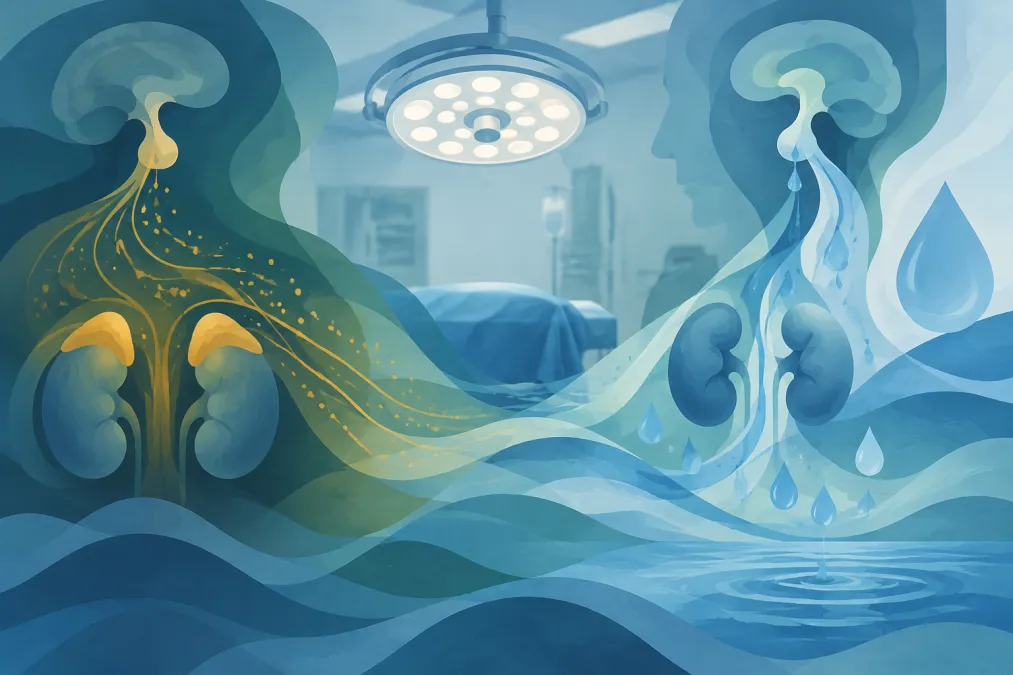
The surgeon asks for extubation. The operation is complete, the monitor is steady, and then comes the viva follow-up: what is the concern now?
For transsphenoidal surgery in Cushing disease, plan around two linked hazards: the systemic effects of cortisol excess before surgery, and possible cortisol deficiency after successful resection. The endocrine plan is part of the anaesthetic plan, not an item to leave until after the airway is secured.
Start with the effects of cortisol excess
Imagine an adult with an adrenocorticotropic hormone (ACTH)-secreting pituitary adenoma, central obesity, hypertension, diabetes and proximal muscle weakness. This is Cushing disease, the pituitary cause of Cushing syndrome. The operation may be familiar; the comorbidity is not routine.
Assess blood pressure and cardiovascular disease, glucose, potassium, other electrolytes, renal function and volume status. Check for infection and investigate the cause of important abnormalities rather than treating each result as a box to tick. Hypokalaemia may reflect cortisol-related mineralocorticoid effects and increases concern about arrhythmia; obtain an electrocardiogram (ECG) when the history or abnormalities warrant it. Stabilise significant blood pressure, glucose and electrolyte problems where time allows.
Assess obesity, reflux, proximal myopathy and symptoms of obstructive sleep apnoea (OSA). These can complicate preoxygenation, ventilation and recovery, but Cushing disease alone does not predict difficult laryngoscopy. Base the airway plan on the examination, previous anaesthetic records, ability to lie flat and respiratory reserve.
Cortisol excess also increases concern about infection and venous thromboembolism. Assess individual risk and agree thromboprophylaxis with the surgical team, balancing it against bleeding in a fresh skull-base operative field. If disease is severe or surgery is delayed, endocrinology may consider cortisol-lowering therapy; it is not an automatic step for every patient.
Optimization should address problems that materially change anaesthetic risk. If surgery is time-critical, for example because of progressive visual compromise, agree what can be corrected immediately and what needs a bridge plan rather than defaulting to an open-ended delay.
Agree the steroid and cortisol plan before induction
Discuss the plan with endocrinology and neurosurgery before surgery. Review current medicines, including antihypertensives, glucose-lowering drugs, anticoagulants, cortisol-lowering therapy and any glucocorticoids used in a block-and-replace regimen. They may affect perioperative decisions and interpretation of postoperative cortisol.
When early cortisol assessment is planned, a clinically stable patient may have cortisol measured before glucocorticoids are given, because treatment can alter interpretation. That is not a reason to delay treatment in an unstable patient or one with suspected adrenal crisis. Medically pretreated patients and those with surgical complications may also need glucocorticoid cover. Agree the intended approach, the timing of assessment, who will review the result and what should prompt treatment.
A strong viva answer distinguishes eventual replacement for postoperative hypocortisolism from the local timing of the first dose. Neither a cortisol measurement nor a steroid plan replaces close observation and a clear rescue plan.
Treat the airway as shared, and protect the surgical field
The transsphenoidal approach uses the nasal route, so the airway and surgical access must be coordinated. General anaesthesia with an oral tracheal tube is usual. Agree the tube position and fixation before draping, keep the circuit accessible and establish how the team will respond if airway access is needed during surgery.
If obesity, OSA or the airway examination raises concern, prepare appropriate positioning, effective preoxygenation, videolaryngoscopy and a rescue plan. Consider awake tracheal intubation when losing spontaneous ventilation would be unsafe. Keep nasal instrumentation available to the surgical team unless they agree otherwise.
Maintain oxygenation, ventilation and cerebral perfusion while providing conditions that allow surgery to proceed. Agree haemodynamic goals with the surgeon; deliberate hypotension is not a substitute for individualized management. Choose monitoring, including an arterial line, according to comorbidity and expected instability.
At emergence, remove any throat pack, clear blood and secretions, confirm full neuromuscular recovery and aim for an awake, smooth extubation. Coughing and straining can worsen bleeding or threaten the repair. Plan the recovery setting and airway rescue options before leaving theatre, especially for a patient with OSA, obesity or a difficult airway. Do not restart continuous positive airway pressure automatically: agree the timing with the surgical team in light of respiratory need and the skull-base repair.
Successful resection can remove the cortisol reserve
Here is the central transition. Before surgery, sustained cortisol excess suppresses normal hypothalamic–pituitary–adrenal (HPA) activity. If the ACTH-secreting tumour is removed successfully, cortisol drive can fall abruptly. A patient who arrived with hypercortisolism may become cortisol-deficient soon after surgery.
Watch for hypotension, nausea, vomiting, weakness, hypoglycaemia or unexpected deterioration. These signs are not specific: assess bleeding, sepsis, volume status and cardiac causes as well. But unexplained hypotension, particularly if poorly responsive to initial treatment, should bring adrenal insufficiency high into the differential. If adrenal crisis is suspected, follow the emergency glucocorticoid pathway without waiting for a laboratory result.
Postoperative cortisol helps the endocrine team assess remission, but its interpretation depends on timing, assay, prior cortisol-lowering treatment and administered glucocorticoids. Low early cortisol supports remission; it does not guarantee that disease will never recur. Patients with postoperative hypocortisolism need glucocorticoid replacement until the HPA axis recovers, with testing and follow-up coordinated by endocrinology.
Watch water balance beyond recovery
Pituitary surgery can disturb arginine vasopressin (AVP) release. Early AVP deficiency (AVP-D), traditionally called diabetes insipidus (DI), presents with increased urine output and inappropriately dilute urine. Serum sodium may rise, but it can remain normal when thirst is intact and water is freely available.
Do not diagnose DI from urine volume alone. Consider perioperative fluid administration, hyperglycaemia and other causes, and interpret urine output alongside thirst, urine concentration and serum sodium or osmolality. Track intake, output and relevant biochemical results according to the unit pathway. Replace water losses and use desmopressin when the clinical and biochemical pattern supports AVP deficiency. Use it thoughtfully: transient DI may settle, and over-replacement can cause water retention and hyponatraemia.
Later, inappropriate antidiuresis can cause delayed hyponatraemia, sometimes after discharge. A triphasic pattern—early polyuria, then an antidiuretic phase and occasionally recurrent polyuria—is an important viva possibility. Before diagnosing the syndrome of inappropriate antidiuresis (SIAD), consider cortisol deficiency, hypothyroidism, desmopressin and the patient’s volume status.
Give the follow-up plan an owner. Specify who checks sodium, when follow-up occurs, what fluid advice applies and how the clinical team can be contacted if symptoms develop. Avoid generic fluid restriction without considering whether DI is present and following the pituitary team’s protocol.
Make the viva follow-up concrete
If potassium is severely low, assess the ECG and associated abnormalities, correct the cause and agree whether elective surgery can proceed safely. If surgery is urgent, describe a coordinated correction and monitoring plan. If the airway looks difficult, name the intended technique, backup device, help available and extubation strategy. If hypotension develops after surgery, consider haemorrhage, volume loss, sepsis and adrenal insufficiency together. If urine output suddenly rises, assess sodium and urine concentration before labelling it DI or giving desmopressin.
For a spoken viva, use the structure in ANZCA Final Viva: How to Structure Your Answer: name the threat, first action, rationale and reassessment. The Final/Advanced Anesthesia Structured Oral Examination (SOE) bank provides cases for rehearsing that reasoning aloud.
The strong answer does not end when the tube comes out. It carries the plan through cortisol assessment and possible replacement, early AVP-deficiency surveillance, delayed hyponatraemia monitoring and a named follow-up pathway. In Cushing disease, removing the source of excess cortisol can expose the deficiency that follows.
Frequently asked questions
How does Cushing disease change the anaesthetic plan?
Plan for the effects of cortisol excess, including hypertension, hyperglycaemia, possible hypokalaemia, obesity or obstructive sleep apnoea, infection risk and venous thromboembolism. Also anticipate possible cortisol deficiency after successful tumour resection.
Does every patient need glucocorticoids after transsphenoidal surgery for Cushing disease?
There is no single perioperative regimen for every patient. Agree how glucocorticoid treatment and postoperative cortisol assessment will be handled, taking account of clinical stability and prior medical treatment. Patients with postoperative hypocortisolism need replacement until hypothalamic–pituitary–adrenal axis recovery.
When can AVP deficiency and hyponatraemia occur after pituitary surgery?
Arginine vasopressin deficiency, traditionally called diabetes insipidus, often appears early. Delayed hyponatraemia from inappropriate antidiuresis can develop later, sometimes after discharge. Early polyuria does not rule out a subsequent antidiuretic phase.
Is polyuria after pituitary surgery always diabetes insipidus?
No. Consider fluid administration, hyperglycaemia and other causes, then interpret urine output alongside urine concentration and serum sodium or osmolality. Desmopressin given without a convincing pattern can cause water retention and hyponatraemia.
What should change if potassium is severely low before surgery?
Assess the electrocardiogram, associated abnormalities and likely cause, and correct the disturbance before elective anaesthesia where possible. If surgery is time-critical, agree a correction and monitoring plan with the relevant teams rather than treating the case as routine.