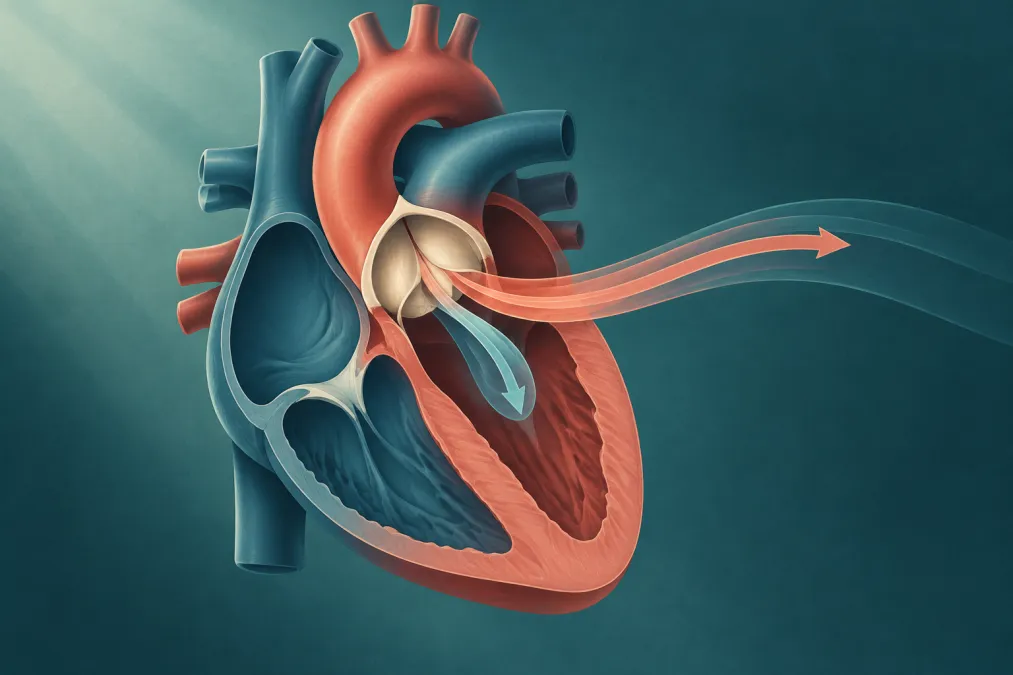
Two systolic murmurs can lead to opposite haemodynamic plans. In aortic stenosis, slowing the heart and preserving afterload may help protect forward flow across a fixed obstruction. In aortic regurgitation (AR), the same reflex can increase backflow. The challenge is to support forward output without sacrificing coronary perfusion or driving the heart rate so high that myocardial oxygen demand rises sharply.
Why regurgitation needs a different plan from stenosis
In AR, blood returns from the aorta to the left ventricle (LV) during diastole. In chronic disease, the LV adapts by dilating and increasing its total stroke volume. Forward output may remain adequate for years, even as wall stress rises and myocardial function gradually declines. A high systolic pressure and low diastolic pressure can widen the pulse pressure, but pulse pressure alone does not grade the lesion.
Bradycardia lengthens diastole, extending the time available for backflow. A sudden rise in systemic vascular resistance (SVR) increases the opposition to forward ejection and can favour regurgitation. That is why a slow heart rate and a deliberate increase in afterload—the familiar aortic-stenosis reflex—cannot be transferred wholesale to AR. Revisit the contrast in this viva on severe aortic stenosis before surgery.
A faster rate shortens diastole and can reduce regurgitant volume per beat. But excessive tachycardia increases myocardial oxygen demand and shortens the time available for coronary perfusion. This matters particularly when aortic diastolic pressure is low, or when coronary disease or LV dysfunction is present. Avoid bradycardia; do not pursue tachycardia as a goal in itself.
Acute severe AR is different from compensated chronic disease. An unadapted LV cannot accommodate the sudden regurgitant volume. LV end-diastolic pressure rises, forward output falls, and pulmonary oedema or shock may follow. The LV may not yet be enlarged, and the colour Doppler jet may be deceptively brief as pressures equalise. Neither a normal chamber size nor a modest-looking jet rules out acute severe AR.
Establish the severity and the ventricle’s reserve
Ask about exertional dyspnoea, declining exercise capacity, orthopnoea, paroxysmal nocturnal dyspnoea, angina and palpitations. Symptoms may be understated when activity has gradually fallen. Look for congestion, arrhythmia and evidence of aortic-root disease. New chest or back pain in a patient with AR raises concern for acute aortic pathology, including dissection.
Transthoracic echocardiography (TTE) should assess more than the colour jet. Review valve and aortic-root anatomy, jet characteristics, LV dimensions and volumes, ejection fraction (LVEF), and associated pulmonary hypertension or valve disease. Findings supporting severe AR include a vena contracta wider than 0.6 cm, regurgitant volume of at least 60 mL per beat, regurgitant fraction of at least 50%, effective regurgitant orifice area of at least 0.30 cm², and prominent holodiastolic flow reversal—particularly when present in the abdominal aorta. Interpret these measures together. Eccentric or multiple jets and loading conditions can distort individual measurements; colour-jet length alone is not a reliable severity measure.
LVEF also needs context. The LV ejects its total contents, including blood that has returned through the aortic valve. A seemingly preserved LVEF can therefore be falsely reassuring in chronic AR. Read it alongside LV end-systolic size or volume and serial change, rather than in isolation.
The 2025 European Society of Cardiology and European Association for Cardio-Thoracic Surgery guideline recommends valve surgery for symptomatic severe AR regardless of LVEF. For asymptomatic severe AR, principal triggers include LVEF at or below 50%, LV end-systolic diameter above 50 mm, or an indexed diameter above 25 mm/m². In selected patients with low surgical risk, earlier surgery may be considered with LVEF at or below 55%, indexed end-systolic diameter above 22 mm/m², or indexed end-systolic volume above 45 mL/m². These findings call for valve-team assessment; they are not automatic anaesthetic cut-offs.
Decide whether the valve or the operation comes first
For suspected moderate or severe AR, review an adequate preoperative echocardiogram and assess symptoms, functional capacity, LV function and expected surgical stress. The current AHA/ACC perioperative guideline considers elective noncardiac surgery reasonable in an asymptomatic patient with moderate or severe AR and normal LV systolic function, defined as LVEF above 55%.
The other side of the decision matters just as much. If severe AR meets standard criteria for valve intervention, consider valve treatment before elective elevated-risk noncardiac surgery when feasible. New symptoms, worsening LV function, significant LV enlargement or acute decompensation call for cardiology and valve-team review rather than a routine proceed decision. If surgery is urgent, plan it with the relevant specialists and monitoring matched to the haemodynamic risk.
Imagine an asymptomatic patient with severe chronic AR, preserved LV function and a stable recent echocardiogram who is scheduled for a low-risk procedure. The valve lesion alone does not automatically require cancellation. Add new breathlessness and a falling LVEF before elective major surgery, and the balance changes: valve assessment comes before simply choosing an induction agent.
Translate the physiology into practical goals
Keep the heart rate in a normal to high-normal range and correct significant bradycardia. There is no universal target; the appropriate rate depends on ventricular function, coronary disease, blood pressure and the cause of AR. Preserve contractility, but avoid unnecessary stimulation that produces marked tachycardia or hypertension.
Maintain preload without flooding a dilated or failing ventricle. A patient with chronic AR may depend on adequate filling, but excess fluid can raise LV filling pressure and precipitate pulmonary oedema. Modest afterload reduction may improve forward ejection; profound vasodilation, however, can lower aortic diastolic pressure and compromise coronary perfusion. Lower afterload is not permission to accept hypotension.
Sinus rhythm is useful, although AR does not impose the same rigid dependence on atrial contraction as severe aortic stenosis. Treat rapid atrial fibrillation or another rhythm disturbance that impairs filling or drives myocardial demand. Maintain oxygenation and ventilation, and avoid hypoxia, hypercarbia and acidosis, particularly when pulmonary hypertension or ventricular dysfunction is present.
Build an anaesthetic that avoids abrupt swings
Use standard monitoring, with an arterial line considered before induction for severe AR, symptoms, LV dysfunction, major surgery or anticipated rapid haemodynamic change. Transoesophageal echocardiography (TOE) can help in selected major cases or when instability needs explanation. Match the intensity of monitoring to the patient and operation.
General, regional and neuraxial techniques can all be appropriate. What matters is how quickly they change preload and SVR. Titrate induction agents to avoid marked bradycardia, myocardial depression and sudden vasodilation. Neuraxial block is not automatically contraindicated, but rapid sympathectomy can lower preload and blood pressure; choose a technique that allows predictable onset and prompt treatment of hypotension.
Treat hypotension by identifying its cause. Check anaesthetic depth, bleeding, rhythm, filling and ventricular performance before reflexively giving fluid or a vasopressor. Give fluid when the patient is likely to benefit. A mixed-acting agent such as ephedrine may suit hypotension accompanied by bradycardia. If vasodilatory hypotension persists, titrate vasopressor support to restore perfusion while avoiding unnecessary SVR elevation. Phenylephrine is not absolutely contraindicated, but a large bolus can increase afterload and trigger reflex bradycardia; it is not the automatic answer. If poor forward output reflects impaired contractility, consider inotropic support with specialist input.
At emergence, prevent pain, shivering and agitation from provoking avoidable haemodynamic swings. Plan postoperative observation according to symptoms, ventricular function, surgical stress and intraoperative events. Severe disease or instability may warrant higher-acuity care.
Acute AR and the viva traps
Acute severe AR with pulmonary oedema, low output or shock needs urgent cardiac and surgical assessment. Stabilisation may include careful support of preload and contractility and reduction of excessive afterload, but it is a bridge to definitive treatment. An intra-aortic balloon pump is contraindicated in moderate-to-severe AR because diastolic inflation can worsen regurgitation; mild AR requires individual assessment.
If AR accompanies acute aortic dissection, do not mechanically apply the chronic rule that a faster rate is better. Aortic impulse control and urgent surgical management require direction from the aortic team. The common viva failure is to treat AR like stenosis: slow the heart, preserve or raise SVR, and respond to every low pressure with pure alpha agonism. A stronger answer balances competing risks: avoid bradycardia and excessive afterload, protect diastolic coronary perfusion, maintain preload without overload, and support contractility without provoking harmful tachycardia.
Rehearse that reasoning in a structured oral format with the Final/Advanced Anesthesia Structured Oral Examination (SOE). The distinction is not simply slow versus fast. It is forward flow without sacrificing coronary perfusion or exhausting the ventricle.
Frequently asked questions
What are the haemodynamic goals in aortic regurgitation?
Avoid bradycardia and excessive afterload while maintaining adequate preload, contractility and coronary perfusion. Aim for a normal to high-normal heart rate, not tachycardia at any cost.
When is elective noncardiac surgery reasonable in a patient with aortic regurgitation?
The current AHA/ACC perioperative guideline considers elective surgery reasonable for an asymptomatic patient with moderate or severe aortic regurgitation and normal LV systolic function, defined as LVEF above 55%. Symptoms, ventricular impairment and whether valve-intervention criteria are met can change the plan.
Why should bradycardia be avoided in aortic regurgitation?
A slower heart rate lengthens diastole, giving blood more time to flow back into the left ventricle. This can increase regurgitant volume per beat and reduce forward output.
Is phenylephrine contraindicated in aortic regurgitation?
Not absolutely. A large, reflexively given dose may raise systemic vascular resistance and slow the heart rate, so it is not the automatic answer to hypotension. Identify the cause and titrate support to restore perfusion without unnecessary afterload.
How does acute severe aortic regurgitation change the anaesthetic plan?
The unadapted left ventricle may rapidly fail, causing pulmonary oedema, low output or shock. Acute severe regurgitation needs urgent cardiac and surgical assessment; haemodynamic stabilisation is a bridge to definitive treatment.
References
Show 7 references
- 2025 ESC/EACTS Guidelines for the management of valvular heart disease
- 2026 Guideline for Perioperative Cardiovascular Management for Noncardiac Surgery
- 2024 AHA/ACC/ACS/ASNC/HRS/SCA/SCCT/SCMR/SVM Guideline for Perioperative Cardiovascular Management for Noncardiac Surgery
- Recommendations for Noninvasive Evaluation of Native Valvular Regurgitation
- Acute aortic regurgitation: a call for urgent intervention
- Intra-aortic balloon pump
- Aortic Insufficiency: Hemodynamic Management, Medical and Surgical Management